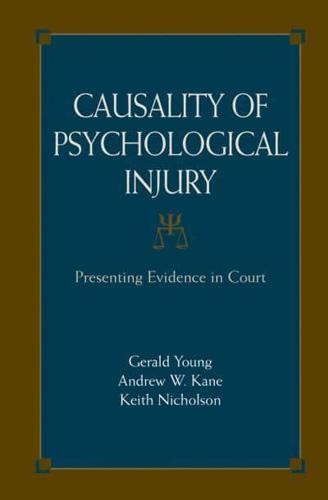
This book offers a welcome expansion on key concepts, terms, and issues in causality. It brings much needed clarity to psychological injury assessments and the legal contexts that employ them. Focusing on PTSD, traumatic brain injury, and chronic pain (and grounding readers in salient U.S. and Canadian case law), the book sets out a multifactorial causality framework to facilitate admissibility of psychological evidence in court.

| ISBN | 1441942149 | | DEWEY edition | DC23 | | ISBN13 | 9781441942142 (What's this?) | | Pages | 660 | | Publisher | Springer-Verlag New York Inc. | | Weight (grammes) | 997 | | Imprint | Springer-Verlag New York Inc. | | Published in | New York, NY | | Format | Paperback | | Height (mm) | 234 | | Publication date | 12 Oct 2010 | | Width (mm) | 156 | | Library of Congress | 2006929451 | | Spine width (mm) | 33 | | DEWEY | 614.15 | | Academic level | Professional / Scholarly |
|
|
|
Chapter 1. Introduction to Causality: Psychological Evidence in Court Gerald Young, Andrew W. Kane, Keith Nicholson. Section I. Causality and Psychological Evidence: Concepts, Terms, Issues. Chapter 2. Causality in Psychology and Law Gerald Young, Andrew W. Kane. Chapter 3. Causality: Concepts, Issues, and Recommendations Gerald Young. Chapter 4. Dictionary of Terms Related to Causality, Causation, Law, and Psychology Gerald Young, Ronnie Shore. Chapter 5. Multicausal Perspectives on Psychological Injury I: PTSD and MTBI Gerald Young. Chapter 6. Multicausal Perspectives on Psychological Injury II: Chronic Pain Gerald Young. Chapter 7. Multicausal Perspectives on Psychological Injury III: Conclusions Gerald Young. Chapter 8. Pain, Affect, Nonlinear Dynamical Systems and Chronic Pain: Bringing Order to Disorder Gerald Young, C. Richard Chapman. Chapter 9. Considering Course and Treatment in Rehabilitation: Sequential and Dynamic Causality Douglas Salmon, Marek Celinski, Gerald Young. Section II. Causality in Court: Psychological Considerations. Andrew W. Kane. Chapter 10. Basic Concepts in Psychology and Law Chapter 11. Conducting a Psychological Assessment Chapter 12. Other Psycho-Legal Issues Chapter 13. Summary and Conclusions Section III. Malingering in Psychological Injury: TBI, Pain, and PTSD. Keith Nicholson, Michael F. Martelli. Chapter 14. Malingering: Overview and Basic Concepts Chapter 15. The Effect of Compensation Status Chapter 16. Malingering: Traumatic Brain Injury Chapter 17. Malingering: Chronic Pain Chapter 18. Malingering: Posttraumatic Stress Disorder and Depression Chapter 19. Malingering: Summary and Conclusions Chapter 20. Causation, Psychology, and Law Daniel W. Shuman, Jennifer L. Hardy. Chapter 21. Conclusions on Causality: Psychological Evidence in Court Gerald Young, Andrew W. Kane, Keith Nicholson. Sources and Citations
From the reviews: "Causality of Psychological Injury: Presenting Evidence in Court is an edited volume with chapters that are not only informative but also well written. The references that I sampled are relevant, useful, and probably as current as any could be in a nonelectronic book ... . surely heightens its educational value to clinical and forensic practitioners and should shape corresponding professional thinking and praxis." (Richard W. Bloom, PsycCritiques, Vol. 52 (37), 2007) "I was delighted to find a concise summary of why third party observers should not be allowed during the course of a forensic neuropsychological examination, touching on such seminal issues as proper test administration, norms, ethical issues as well as legal precedents prohibiting this practice. The summary was so well done. ... This information was also quite helpful in formulating the expert affidavit ... . I found this volume to be responsive to some very different dilemmas I encountered in my civil practice." (Jerid M. Fisher, Archives of Clinical Neuropsychology, December, 2007) "Causality of Psychological Injury ... addresses issues pertinent to psychological assessment in personal injury cases in a well-organized, comprehensive, and authoritative manner. ... The writing is clear and concise, and is useful for both those who wish to expand their practice into this area of forensic psychology, as well as the more experienced forensic psychologist or psychiatrist ... . Causality of Psychological Injury fills a serious gap in the forensic psychological literature ... . I recommend it without reservation." (Eric G. Mart, Psychological Injury and Law, Vol. 1, 2008)

Be the first to write a
customer review